Product Detail
How to Choose a Steel Pallet
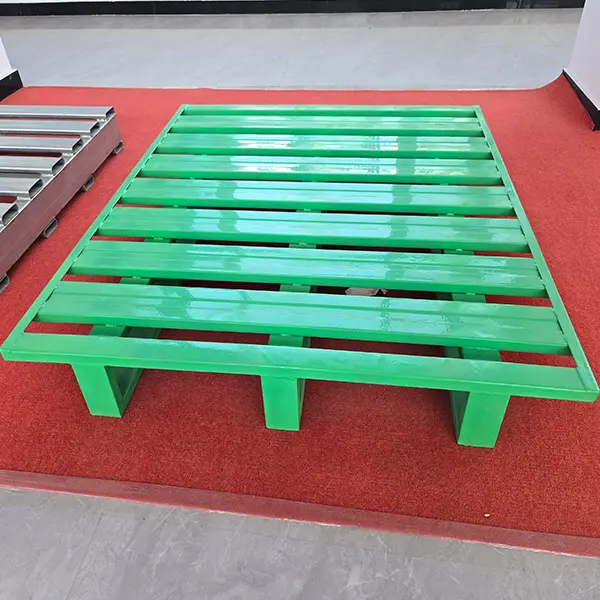
A Practical Guide to Choosing Steel Pallets
Choosing the right steel pallet is about more than just size or load capacity. The pallet must be compatible with your products, material handling equipment, storage methods, warehouse environment, and transportation requirements.
Pallets suitable for general warehouse storage may not be suitable for heavy machinery, refrigerated storage, outdoor handling, or concentrated loads. Selecting the correct configuration can effectively improve the load stability, handling efficiency, storage utilization, and service life of steel pallets.
On This Page
Table of Contents
1. Start with Load Requirements
The first step is to determine the weight the pallet needs to support. Do not consider only the total weight of the goods; you should also take into account the weight distribution and how the pallet will be handled.
Key load factors include:
Total product weight, stacking load, concentrated load, and handling frequency
What load capacity should you choose?
When determining the required load capacity, base your decision on the expected maximum load rather than the average load.
If the pallets will be stacked, the stacking load must also be considered separately.
If your heavy goods require frequent handling with forklifts, structurally reinforced pallets may be more suitable for you than lightweight designs.
2. Choosing the Right Pallet Size
Pallet size should be determined by your product dimensions and your storage and transportation systems.
First, you need to measure:
product length, product width, product height, product weight, and available warehouse space
Second, the pallet should provide adequate support for the cargo, but its size should not be unnecessarily large. Oversized pallets may take up extra warehouse and transportation space, while undersized pallets may cause the product to lose support or become unstable.
You should also consider your logistics system, pallet dimensions should be compatible with:
trucks, shipping containers, forklifts, pallet jacks, and existing pallets or containers.
If the pallets will be used for international shipping, please consider the dimensions of the transportation and loading systems before selecting non-standard sizes. We will do our best to help you maximize pallet loading capacity within containers and reduce shipping costs.
3. Choosing Between Solid and Open Decks
One of the most important configuration choices is the pallet deck; the appropriate deck depends on the product’s size, shape, weight, and stability requirements.
Solid-deck steel pallets: Provide a continuous support surface with a sturdy deck.
They are suitable for the following situations:
Products with a small contact area;
Small parts that might fall through openings;
Goods that require continuous support;
Boxes or containers that need a stable surface;
The load needs to be distributed over a larger surface area.
A solid deck also makes it easier to place certain types of cargo directly onto the pallet.
Open-deck steel pallets: Open decks use spaced wire mesh, rebar, tubing, or support members.
Consider this option when:
Products are relatively large;
Full deck coverage is not required;
A lighter pallet weight is preferred;
Ventilation is beneficial
Goods are already packed in boxes or containers
You should consider the smallest items that will be placed directly on the pallet; if small products might fall through the openings or require continuous support, a solid deck may be more appropriate.
If the products are large, rigid, or already contained, an open deck can provide sufficient support, making an open steel pallet a better choice.
4. Check Compatibility Between Forklifts and Pallets
Your pallets should be compatible with the equipment used to move them. Before purchasing, check the following:
fork opening dimensions, fork height, fork width, and entry direction, among other factors.
Two-way access pallets allow for handling from two directions.
Four-way access pallets provide access from multiple directions and offer greater flexibility in busy warehouse environments.
If pallets are frequently repositioned from different directions, four-way access can make material handling more convenient; however, the final configuration should always be based on the forklifts or pallet trucks actually used in your facility.
5. Selecting the Appropriate Surface Finish
The surface finish should be appropriate for the environment and intended conditions of use.
Powder Coatings
Powder coatings provide a durable finished surface and are available in a variety of colors; they are suitable for general indoor warehouse and manufacturing applications.
Galvanized Surface Finish
Galvanizing provides additional corrosion protection and should be considered for humid environments, outdoor applications, or situations requiring higher corrosion resistance.
6. Should You Add Casters? Choose Based on Your Handling Needs
When selecting steel pallets, consider whether the pallets will remain in a fixed storage location or need to be moved frequently within the facility. Adding casters can transform a standard steel pallet into a mobile handling unit, while stationary pallets are typically better suited for stacking, static storage, and forklift handling.
| Steel Pallet Without Wheels | Steel Pallet With Wheels | |
| Main Use | Storage and forklift handling | Storage + internal transportation |
| Mobility | Requires forklift or pallet truck | Can be moved manually or with suitable handling equipment |
| Frequent Movement | More suitable when movement is occasional | Suitable for frequent short-distance movement |
| Floor Storage | Excellent | Suitable |
| Stacking | Easier to design for stacking | Depends on caster and stacking design |
| Production Lines | Requires additional handling equipment | Convenient for moving materials between workstations |
| Warehouse Handling | Best for pallet-based handling | Best for flexible internal movement |
| Cost | Generally simpler | Additional cost for casters and reinforced structure |