Product Detail
How to Choose the Right Load Capacity
The Importance of Choosing the Right Load Capacity
When purchasing stacking racks, storage cages, stackable shelving, steel bins, and other storage racks specifically designed for vertical stacking, selecting the appropriate load capacity is a critical step.
On This Page
Table of Contents
Selecting the load capacity does not simply mean choosing equipment with a higher rated load. When racks are stacked vertically, the load borne by the bottom rack may far exceed the load capacity of a single rack. Therefore, when determining the correct load capacity, you should comprehensively consider the weight of the goods being stored, the number of stacking levels, the equipment structure, the handling methods, and the actual operating environment.
Understanding the Meaning of “Load Capacity”
Before comparing different products, be sure to clarify exactly what the rated load capacity refers to. For stacking racks and similar equipment, manufacturers may specify different types of load capacities, such as:
Single-rack load capacity
Single-tier storage load capacity
Maximum stacked total load
Maximum stacking capacity
Static load capacity
Dynamic (handling) load capacity
Never treat these terms as simply interchangeable concepts.
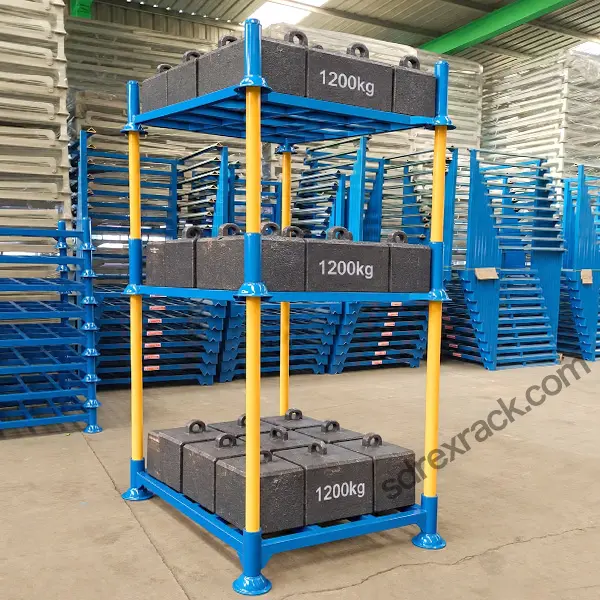
For example, a stacking rack may have a rated load capacity of 1,000 kilograms. If multiple racks are stacked vertically, the bottom rack must support not only the weight of its own cargo but also the additional load from the racks above and their cargo.
Calculating the Actual Weight of the Cargo
Start by calculating the weight of the products you plan to store. Determine the expected maximum weight rather than relying solely on the average weight.
For example, if a storage unit contains 20 boxes, each weighing 50 kilograms:
20 × 50 kilograms = 1,000 kilograms
Therefore, a single shelving unit must be capable of supporting this 1,000-kilogram load, while also accounting for variations in product weight. If certain batches of products are heavier, the expected maximum operational load should be used as the basis for determining the required load-bearing capacity.
You should provide the manufacturer with the following information:
Maximum product weight
Number of items per rack
Weight of pallets or containers
Based on this information, we will provide you with a more practical structural design.
Account for the Weight of the Storage Equipment Itself
During vertical stacking, the load to be supported is not limited to the stored goods. When multiple racks or containers are stacked vertically, the bottom unit may also need to support the weight of the equipment above it.
For example, consider a vertical stacking configuration consisting of three loaded racks.
The bottom unit must support:
Its own cargo load
The dead weight of the second rack
The weight of the cargo stored in the second rack
The dead weight of the third rack
The weight of the cargo stored in the third rack
Quick Guide to Choosing the Right Load Capacity
| Factor | What to Check |
| Product Weight | Maximum weight of stored goods |
| Rack Weight | Weight of the empty storage unit |
| Unit Load | Total load carried by one unit |
| Stack Height | Number of vertically stacked units |
| Stack Load | Combined load within the complete stack |
| Structure | Frame, supports, base and stacking points |
| Forklift | Capacity, load center and lifting height |
| Floor | Rated floor capacity and condition |
| Handling | Static storage or frequent movement |
| Future Loads | Potential increase in weight or product size |
Final Thoughts
Selecting the correct load capacity for vertically stacked storage equipment requires examining the entire storage configuration, rather than relying solely on a single number printed on a product specification sheet. Most importantly, it is essential to distinguish between the load capacity of a single unit and the load capacity allowed when multiple units are stacked vertically.
If you are planning a new stacking rack or stackable storage system, please contact us and provide details such as product dimensions, maximum load weight, and warehouse height. Based on this information, we can determine the appropriate stacking rack structure, dimensions, and number of stacking levels for your application.