Product Detail
How to Choose the Right Tire Rack
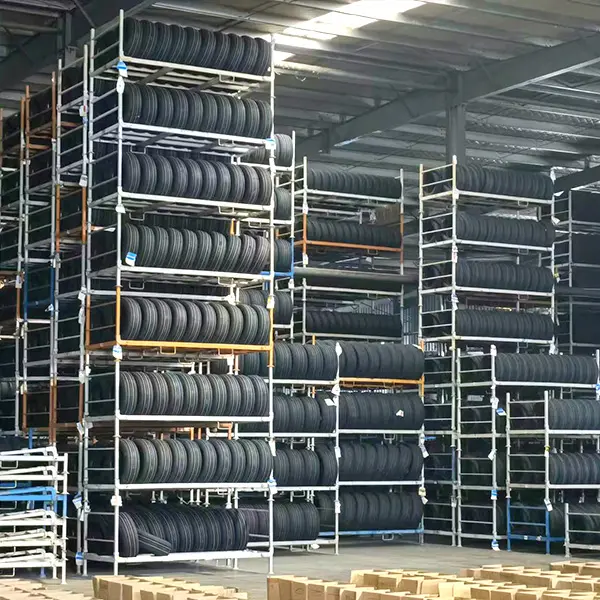
The Importance of Choosing the Right Tire Racks
Selecting the right tire storage rack is crucial for the organized storage, protection, and convenient handling of tires, while also helping you make efficient use of warehouse space. Different types of tires vary significantly in diameter, width, weight, and storage requirements. Therefore, the appropriate tire racking system must be tailored to your tire sizes, load capacity requirements, warehouse layout, material handling equipment, and expected storage volume, while also providing sufficient structural strength and stability to withstand repeated loading and unloading operations.
This guide will help you determine the tire rack solution best suited to your specific operating conditions.
On This Page
Table of Contents
Identify the Types of Tires to Be Stored
First, clearly identify the categories of tires your tire racks will hold. Passenger car tires, truck tires, SUV tires, agricultural tires, and motorcycle tires vary significantly in size and weight. Even within the same category, tire specifications can differ considerably.
Therefore, before selecting a model, please confirm the following information:
Tire type, tire diameter, tire width, and whether multiple tire sizes need to be stored on the same rack.
If your warehouse stores multiple types of tires, you’ll need to decide whether to use a universal rack compatible with all sizes or specialized racks designed for specific sizes to achieve better storage efficiency.
Verify the Actual Tire Dimensions
Tire dimensions are one of the most important factors to consider when selecting tire racking.
Please measure the actual dimensions of the tires to be stored. Do not rely solely on the tire’s nominal specifications; also consider the tire’s overall diameter and width, as these determine the number of tires that can be stored per rack bay and the required clearance.
For example: Racking designed for passenger car tires cannot meet the storage requirements for large truck tires. Selecting the appropriate size specifications can prevent tires from protruding excessively or creating a significant amount of wasted space.
Determine the Required Load Capacity
The tire rack must be able to support the total weight of the stored tires.
Calculate the maximum expected load based on the number of tires stored per rack and the weight of a single tire.
Calculation formula: Number of tires × Average/Maximum weight per tire × Number of stacking layers ≈ Approximate load capacity of one tire rack
However, selecting the right model should not rely solely on simple calculations; it also requires a comprehensive consideration of load distribution, the tire rack structure, stacking methods, and handling methods. Matching appropriate load-bearing standards not only enhances operational safety but also extends the service life of the tire racks.
Determine the Tire Storage Method
Tire racks can accommodate different orientation and handling modes.
The appropriate structural solution depends on the type of tires, warehouse operations, and the frequency of tire access.
You need to confirm your operational requirements:
- Vertical tire storage
- Horizontal tire storage
- Cross-stacking of tires
- Storing multiple tires per bay on the tire rack
The core objective is to balance storage density with ease of access. A highly compact layout can increase storage capacity but makes it more difficult to retrieve individual tires. If tires require frequent picking and handling, prioritize ease of access to facilitate rapid movement by forklifts.
Consider the Maximum Stacking Height
A major advantage of tire racking is the full utilization of vertical warehouse space. However, the maximum stacking height is limited by the rack’s structural design, tire weight, tire dimensions, warehouse ceiling height, and handling equipment.
Before determining the stacking height, consider the following:
- Warehouse ceiling height
- Load-bearing capacity of the tire racks
- Number of stacking levels on the tire racks
- Maximum lift height of the forklift
- Required safety clearance above the racks
- Local occupational safety regulations
Higher is not necessarily better when it comes to tire racks; generally, 3–6 layers are recommended. The specific stacking system should balance storage density, safety, and ease of access.
Confirm Forklift Compatibility
Large warehouses and distribution centers typically use forklifts to handle heavy-duty tire racks, so the tire racks must be compatible with the forklifts in use at the facility.
Be sure to verify the following:
- Forklift type
- Forklift rated load capacity
- Fork dimensions
- Fork entry direction
- Required lift height
If fully loaded racks need to be moved frequently, the racks must be designed with appropriate fork entry points and ensure structural strength. You can provide us with your forklift specifications, and we will design a suitable tire rack chassis structure that is compatible with your handling equipment.
Consider the Rack Structure Type
The rack structure must match your actual usage scenario. Heavy-duty tire racks require higher strength in their frames and support components compared to racks designed for storing lightweight passenger car tires.
You can choose based on your operating conditions:
- Foldable tire racks
- Tire racks with removable uprights
- Custom tire storage racks
- Tire display racks
Foldable or removable tire racks help you save on shipping costs and facilitate the return of empty racks.
Summary
When selecting tire racks, don’t just consider whether they can hold the tires. The design of the tire racks must account for tire dimensions, total load capacity, storage density, material handling equipment, warehouse layout, and operational conditions.
Whether you handle passenger car tires, truck tires, motorcycle tires, or a mixed inventory of multiple sizes, the optimal solution will vary. Choosing the right tire rack allows you to fully utilize vertical space, organize your tire inventory, improve handling efficiency, and create a safer storage environment.
If you’re unsure which racking solution is best suited for your warehouse, please provide the tire specifications, weight, purchase quantity, warehouse dimensions, and forklift specifications. Based on your needs, we’ll recommend suitable tire rack dimensions, load capacity, structure, and surface treatment, and provide a one-stop solution.