Product Detail
Warehouse Rack Safety Standards
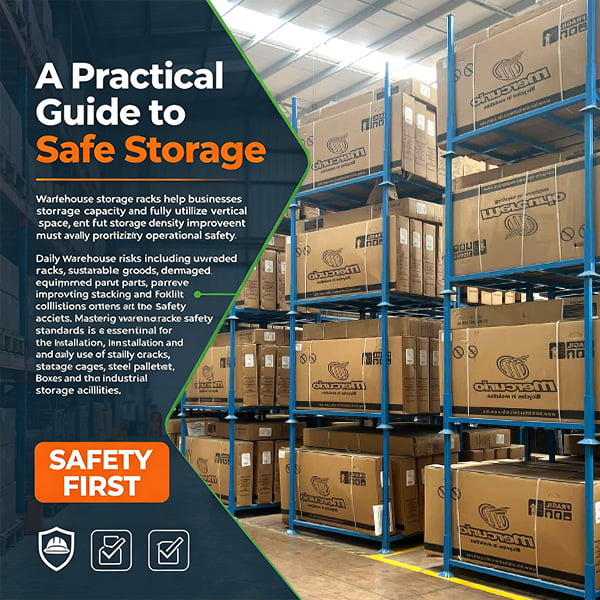
A Practical Guide to Safe Storage
Warehouse storage racks help businesses expand storage capacity and fully utilize vertical space, yet storage density improvement must always prioritize operational safety. Daily warehouse risks including overloaded racks, unstable goods, damaged equipment parts, improper stacking and forklift collisions often lead to safety accidents. Mastering warehouse rack safety standards is essential for the selection, installation and daily use of stacking racks, stillage cages, steel pallet boxes and other industrial storage facilities.
On This Page
Table of Contents
Basic Definition and Coverage of Rack Safety Standards
Warehouse rack safety standards are normative requirements and guiding practices to ensure the stability and safety of storage equipment and goods during operation. They cover rack load capacity, structural strength, load distribution, stacking height, installation specifications, forklift operation, aisle clearance, equipment inspection and maintenance repair. Specific requirements vary according to rack types, warehouse environments, regional regulations and usage scenarios. Fixed pallet racks, movable stacking racks and stillage cages have different structural and operational standards, so storage equipment shall be selected based on actual product weight, size, handling mode and stacking structure.
For American warehouses, OSHA’s 29 CFR 1910.176 regulation stipulates that stored goods shall not pose safety hazards. Tiered stacked materials need to be fixed and interlocked with height limits to prevent sliding and collapse. The standards also require unobstructed and well-maintained access aisles with sufficient safe clearance. Core OSHA guidelines include never exceeding rack load limits, conducting regular equipment inspection and maintenance, and isolating damaged racks for professional evaluation, repair or replacement. The basic safety principles are secure storage, rated load use, clear aisles and regular inspection.
ANSI MH16.1 is a key industry consensus standard for American industrial steel storage racks, covering rack design, load conditions, component specifications, anchoring installation and operational norms. It is recognized by OSHA as an authoritative industry guideline, though it does not belong to mandatory OSHA regulations. For warehouse operators, racks must be designed and selected according to actual load and operating conditions instead of simply referring to appearance and size.
Core Load Safety Management Specifications
Load capacity is the core factor of rack safety. All racks must be used within the manufacturer’s rated load range. Overloading will cause excessive pressure on uprights, supports, welding parts and connecting structures, damaging rack stability. When selecting equipment, enterprises need to comprehensively consider product weight, size, load distribution, rack structure, stacking layers and handling methods. Even goods with the same total weight may cause different structural pressures due to uneven distribution. It is forbidden to estimate load capacity by visual experience, and customized racks need clear load parameter requirements provided by manufacturers.
Rack safety relies on both load weight and load placement. Goods must be placed within the rack’s effective support area in line with design standards. Unreasonable load distribution will trigger structural stress concentration, goods displacement, falling objects and rack deformation. For stacking racks, operators need to guarantee centered load placement and reasonable center of gravity, without goods exceeding the support range. OSHA clearly requires neat and stable storage to avoid collapse and falling hazards.
Vertical stacking improves space utilization, but stacking height cannot be determined by building height alone. Safe stacking height is restricted by rack design, rated load, product specifications, floor conditions, stacking mode, forklift performance, building clearance and local safety codes. The maximum stacking layers must follow manufacturer specifications and on-site operational requirements. The core goal of high stacking is to balance storage density, structural stability and handling safety, rather than pursuing maximum height blindly.
On-Site Operation and Layout Safety Rules
Forklift collision is the main cause of rack damage. Even low-speed impacts can deform rack uprights, brackets, base plates and connecting parts, reducing overall structural stability. OSHA standardizes forklift operation norms, requiring stable loading, rated load use, reserved safety clearance and standard stacking operations. Warehouses shall formulate standardized processes for rack loading and unloading, turning operation and collision reporting, and set up physical protection devices in high-frequency forklift operation areas to reduce collision risks.
Storage density optimization cannot occupy safe operating space. Aisle width shall match forklift type, turning radius, goods size, warehouse layout and pedestrian flow. OSHA mandates unobstructed and intact passageways. Warehouse layout design must balance three core indicators: storage density, operational accessibility and safety. A layout with theoretical maximum storage capacity is impractical if it cannot support safe forklift access and goods handling.
Regular inspection is the key to maintaining long-term rack safety. Warehouse staff shall regularly check for bent uprights, deformed brackets, cracked welds, loose parts, equipment corrosion, inclined structures and missing components. Special inspections must be carried out after equipment collisions and abnormal incidents. Timely daily inspection can eliminate potential safety hazards before structural failure occurs.
Equipment Inspection and Damage Handling Standards
Damaged racks must not be put into use despite apparent intact bearing capacity. Once damage is found, the corresponding area shall be unloaded, isolated and marked. Professional technicians shall conduct safety evaluation, and damaged equipment can only be reused after standardized repair or replacement. Ignoring minor damage may lead to overall rack collapse and major safety accidents.
Special Storage Equipment Safety Requirements
Any unauthorized modification of racks is prohibited. Disassembling supports, adding stacking layers, changing dimensions, random welding and replacing components will alter the original load-bearing structure and destroy safety performance. If warehouse layout adjustment is needed, professional overall evaluation and redesign are required instead of informal modification.
When purchasing warehouse racks, besides price and size, enterprises shall confirm matching load capacity, adaptive product dimensions, reasonable stacking layers, compatible forklift handling modes, applicable usage environments and convenient later inspection and maintenance conditions to ensure long-term safe operation.
Before formal operation, warehouses shall conduct comprehensive safety confirmation. Check rack assembly integrity, structural soundness and clear load identification; ensure all goods are within rated load limits, stably placed and stacked at qualified height; verify forklift operators are professionally trained with standardized operation and timely hazard reporting; guarantee unobstructed aisles and emergency passages; implement regular inspection mechanisms and prohibit damaged equipment and unauthorized modifications.
Procurement Guidelines and Pre-Operation Safety Checks
In conclusion, warehouse rack safety is a systematic project integrating regulations, equipment and operation. U.S. warehouses need to coordinate OSHA mandatory rules and ANSI MH16.1 industry standards. For common storage equipment including stacking racks, stillage cages and steel pallet boxes, the core safety norms are clear: select matching equipment, prohibit overloading, stabilize goods placement, keep passages unobstructed, train operators, conduct regular inspection and eliminate damaged equipment. Scientific warehouse management balances storage capacity, space utilization and operational safety, creating an orderly and secure storage environment.
Choose heavy-duty rack that meets safety standards
Stacking racks are suitable for warehouses needing flexible vertical storage improvement without fixed installation. Their safe use requires strict compliance with rated load and approved stacking layers, centered and stable load placement, aligned rack assembly, qualified bearing floors and standardized forklift handling. Stacking racks shall be customized according to actual storage scenarios instead of being used as general steel frames.
Stillage cages and steel pallet boxes are widely used for storing industrial parts and metal products. Their safety depends on rated load capacity, base structural strength, welding quality, mesh panel integrity, standard forklift holes and compliant stacking layers. These devices have fixed load and height limits, and daily inspections shall focus on deformed parts, damaged feet, broken welds and excessive corrosion to ensure handling safety.