Product Detail
Warehouse Storage Optimization
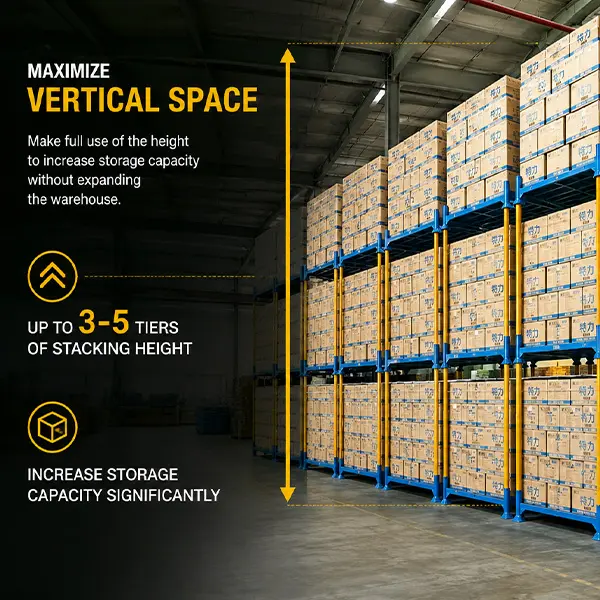
How to Maximize Vertical Space and Storage Capacity
Warehouse storage optimization doesn’t always mean adding equipment or expanding the warehouse. In many warehouses, there is actually a significant amount of storage space above ground level that often goes unused.
On This Page
Table of Contents
When floor space is limited, making better use of vertical space is one of the most practical ways to increase storage capacity. By using high-bay racking, stackable shelving, storage cages, steel pallet boxes, and other stackable storage equipment, warehouses can safely utilize higher storage levels while maintaining product organization and ease of access.
This approach is particularly well-suited for warehouses handling palletized goods, tires, metal parts, automotive components, coiled materials, industrial materials, and other products that can be stored in standardized storage units.
Let’s explore some practical warehouse storage optimization strategies to improve warehouse operational efficiency, including increased vertical space utilization, higher storage density, optimized product organization, and more flexible handling and turnover.
What Is Warehouse Storage Optimization?
Warehouse storage optimization refers to the process of making better use of existing warehouse space while ensuring safe, orderly, and efficient storage operations.
Traditional warehouse layouts often place too much emphasis on floor space. Products are placed on pallets, directly on the floor, or in separate storage areas. As inventory grows, even if vertical space remains plentiful, a warehouse can quickly run out of available floor space. A more effective approach is to view the warehouse as a three-dimensional storage environment.
Rather than asking, “How much floor space do we have?”
warehouse operators should also ask, “How much vertical space can we safely utilize?”
Why Is Vertical Space Critical in Warehouse Storage?
Floor space is one of the most valuable resources in a warehouse. Once floor space is fully occupied, it becomes very difficult to increase inventory without expanding the warehouse.
However, many warehouses have unused headroom between stored products and the ceiling.
For example, a warehouse may have a clear height of 6 meters, 8 meters, or even 10 meters, yet products are stored only at ground level. This results in a significant waste of vertical space.
Vertical storage optimization helps transform this unused space into usable storage capacity, but the key is not simply stacking products higher. Therefore, the design of our storage systems must be based on **load capacity, rack dimensions, product characteristics, stacking height, material handling equipment, and the warehouse environment**.
How can storage be optimized based on product dimensions?
Warehouse storage efficiency is closely related to product dimensions.
Storage units that are too large result in a waste of valuable space; units that are too small may hinder efficient loading or pose safety hazards. Before selecting stacking racks or storage cages, consider the following factors:
Product length, Product width, Product height, Product weight, Load distribution, Packaging type, Forklift entry direction, Required stacking height, Access frequency
For example, the storage method for tires is completely different from that for rolls of fabric or metal parts.
Similarly, automotive parts may be better suited for mesh storage cages, while heavy-duty palletized goods are better suited for heavy-duty stacking racks.
Customizing rack dimensions helps reduce wasted space between storage units, thereby improving the overall utilization of warehouse space.
Establishing High-Density Storage Zones
Another effective warehouse storage optimization strategy is to divide the warehouse into dedicated storage zones.
Instead of mixing various products throughout the facility, the warehouse can establish separate zones based on product type, size, weight, turnover rate, or handling requirements.
For example:
Heavy-Duty Goods Storage Zone
Used to store heavy industrial products, palletized goods, metal parts, or bulk materials.
Recommended Equipment: Heavy-duty stacking racks and steel pallet cages.
Parts Storage Zone
Used for storing smaller parts and loose components.
Recommended Equipment: Storage cages and mesh pallet cages.
Tire Storage Zone
Designed according to tire dimensions and stacking requirements.
Recommended Equipment: Tire stacking racks and specialized tire storage racks.
Fabric Roll Storage Area
Designed to accommodate fabric rolls of varying widths and diameters.
Recommended Equipment: Fabric roll storage racks and custom stacking racks.
Establishing dedicated storage areas not only reduces wasted space but also makes it easier for forklift operators to identify and access different product categories.
Reducing Gaps Between Storage Units
Optimizing vertical space is only one aspect of improving warehouse storage efficiency; horizontal layout is equally critical. Excessive gaps between storage units, overly wide aisles, and inconsistent storage dimensions all reduce a warehouse’s actual storage capacity.
An effective warehouse storage layout should balance the following three factors: storage density, ease of access, and material handling safety
Reducing unnecessary gaps can increase the number of storage locations within the same warehouse floor area. However, when narrowing aisle widths, we must also fully consider forklift turning radii, cargo dimensions, operator visibility, and emergency aisle requirements. Our goal is not to create the narrowest possible aisles, but rather to design a highly efficient storage layout that makes effective use of space while maintaining practical operating conditions.
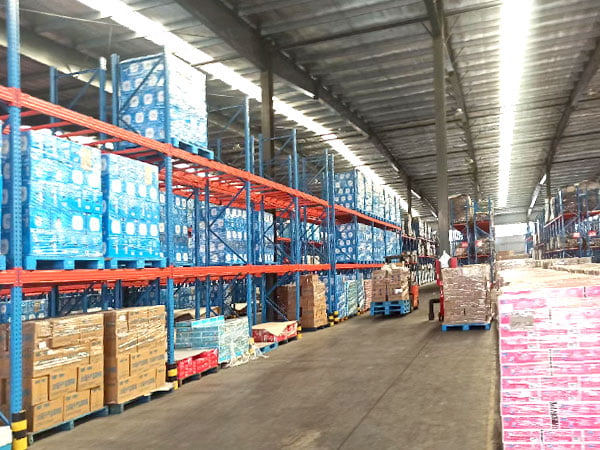
How to Increase Warehouse Storage Density?
Stacking racks are one of the most practical solutions for vertical warehouse storage.
Stacking racks allow for the vertical storage of individual items without the need for traditional fixed rack structures at every storage location. Depending on the rack design and load requirements, multiple units can be safely stacked on top of one another, ultimately helping you achieve higher storage density without increasing the warehouse’s floor space.
Storage optimization does not mean you must use only a single type of equipment; a more practical approach is typically to select and implement different storage solutions based on the characteristics of the products.
For example:
Heavy-duty palletized goods → Stacking racks
Small components → Storage cages
Bulk industrial parts → Steel pallet boxes
Long materials → Specialized stackable racks